Gates of Olympus Bonus Round
There are three ways into the free spins round: wait for it, improve the odds with Ante Bet, or buy it outright. All three cost something different.
Trying the Bonus Round in Demo
See for yourself how the buy button and the Ante Bet switch behave, without putting money at risk. The demo balance is virtual and nothing can be withdrawn.
In Gates of Olympus the word bonus covers two different things, and they are constantly mixed up. The first is the game’s own free spins round — it opens through Scatter symbols, carries no wagering requirement and pays straight into your balance. The second is whatever promotion the site you play at happens to offer, which is governed entirely by the operator’s rules. This page is mostly about the first one.
How the Bonus Round Opens
The trigger symbol is the Scatter carrying the portrait of Zeus. When four or more land on screen at the same time, 15 free spins begin. Where the Scatters sit does not matter; as everywhere else in this game, it is the count that is read, not the position.
At the moment of triggering, the Scatters also pay on their own: four give 3 times the total bet, five give 5 times and six give 100 times. That payment is separate from the bonus round and lands in the balance before the spins start.
There are three routes into the round and their costs differ sharply. The table below compares how the three approaches behave on the same budget.
| Method | Cost per round | Rounds on the budget | When it makes sense |
|---|---|---|---|
| Standard bet | 1 unit | 100 rounds | Long session, small budget, learning the mechanics |
| Ante Bet | 1.25 units | 80 rounds | Raising your chance of seeing the bonus without overreaching |
| Buy bonus | 100 units | 1 round | A player interested only in the bonus, with a bankroll to match |
How Buying the Bonus Works
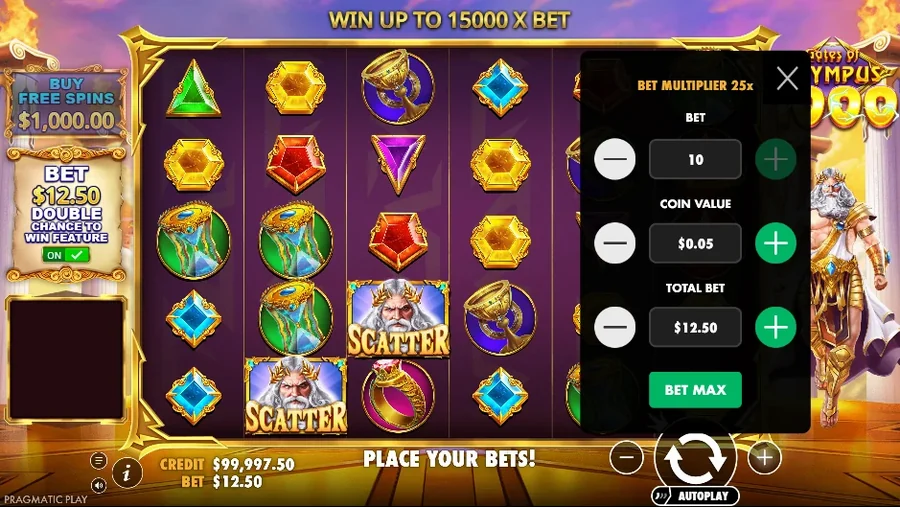
The left panel carries the purchase price and the Double Chance switch.
The purple panel on the left of the screen, marked Buy Free Spins, is what takes you straight into the round. The figure on it is not fixed: it shows 100 times your current stake and updates the instant you change your bet. In the capture above, a stake of 12.50 units produces a purchase price of 1,000.
The Double Chance switch just below it is the Ante Bet. Turned on, it raises the stake by 25% and increases how often Scatters appear. Worth noting: the two features cannot be used together — with Ante Bet active, the buy button is disabled.
Press buy and a confirmation screen appears, the amount is deducted and 15 spins start immediately. Those spins follow exactly the same rules as a naturally triggered round: multipliers accumulate, three Scatters add five spins, and the ceiling is still 5,000x.
Worth knowing: if a purchased round comes up short, the 100x you paid is gone. On a balance that cannot absorb at least fifteen to twenty purchases, this option can end a session in a single round.
The Maths of Buying: What to Expect
Providers tune the buy option so its theoretical return sits very close to that of the base game. In practice, that means paying 100 units and expecting roughly 96 back on average. The word average is doing a lot of work in that sentence — you will not see it in any single round.
The large majority of purchased rounds close below their cost. A small minority, carried by accumulated multipliers, pay back many times the price, and that minority alone holds the average up. Buying, in other words, converts the same expected value into a far sharper distribution.
The practical consequence is straightforward. If you are treating a purchase as a one-off experiment, accept in advance that disappointment is the likely outcome. If you intend to do it regularly, your balance needs to absorb at least fifteen purchases; otherwise the budget runs out before you ever reach the good tail of the distribution.
A concrete example makes this clearer. Suppose you set your stake to 1 unit and make fifteen purchases from a 1,500-unit balance. Most of those rounds will close somewhere between 20 and 60 units, a few will edge past their cost, and realistically only one will produce something genuinely striking. Total return lands in the region of 1,400. Spread the same balance across 1,500 standard spins and the expected return is similar in cash terms — but you see far more small payouts along the way and the session lasts much longer. The choice is about what kind of experience you want from the same money.
Choosing Between Ante Bet and Buying
Ante Bet pays 25% more on every round to raise the frequency of Scatters. The game’s theoretical return barely moves in this mode; what changes is how many rounds the same budget covers and how often you see the bonus.
Ask yourself one question when deciding: how many rounds does your budget cover? Above a hundred, Ante Bet genuinely lifts your chance of reaching the bonus by a meaningful margin. Switching it on with a twenty-round budget does nothing except burn the balance faster.
Buying is a different decision altogether. There you are not purchasing the game, you are purchasing the outcome: skipping the rhythm of the base game, the waiting and the small wins to land directly in the bonus. That makes sense for players who already know the game and care only about the variance of the bonus round.
One last caution: pressing the buy button repeatedly does not change the game’s maths, but it is the riskiest habit psychologically. Each purchase is independent; three weak rounds in a row give you no reason at all to expect the fourth to deliver. If you are going to buy, decide how many you will buy before the session starts and hold to that number.
How Multipliers Build Up in Free Spins
This is where the bonus round truly parts ways with the base game. In a normal round, the orbs that land are summed, applied to that round’s win and then cleared. During free spins, every orb is added to a shared pool, and the total in that pool is preserved until the round ends and applied to each new win.
Take an example. If the first three spins drop orbs worth 5x, 10x and 25x, the pool stands at 40x. If the fourth spin produces a raw win of 3 units from the paytable, it pays out as 120. Wins late in a round look enormous not because the symbols changed, but because the pool grew.
That is also why the five spins added by three Scatters are so valuable: they buy time without resetting the pool. The Gates of Olympus 1000 edition pushes the same logic further, raising orb values as high as 1000x — we went through the differences one by one on the edition comparison page.
Do Not Confuse This With Casino Promotions
The in-game bonus round and an operator’s welcome bonus are entirely different things, and putting them in the same category is the most common mistake players make.
The in-game bonus round
Opened by Scatters or purchased outright. No wagering requirement, the win lands directly in your balance and can be withdrawn whenever you like. The rules are set by Pragmatic Play and are identical at every site.
An operator promotion
Granted for registering or depositing. Usually carries 30x–40x wagering, imposes a maximum bet while wagering and weights some games lower than others. The rules are set by the operator and vary from site to site.
If you do take a promotion, read three lines in particular: the wagering multiple, the maximum bet allowed while wagering, and the contribution percentage for slots. Exceeding the bet cap during wagering voids the bonus and any winnings from it at most sites — and that is usually applied automatically by the system.
How Often the Bonus Arrives
There is no exact figure to give here, but there is a range. At a standard stake, four Scatters landing together happens on average once every few hundred spins. With Ante Bet active that interval narrows noticeably — which is the only reason the provider offers the option at all.
It is worth being precise about what average means. An average of two hundred spins does not mean a bonus every two hundred spins. Two bonuses in a row and eight hundred spins without one are both ordinary results of the same distribution. Because the game does not remember previous rounds, a long drought never improves the odds of the next spin.
The practical conclusion: if you are playing with the bonus round as your goal, your budget has to be split so it covers at least a few hundred rounds. Waiting for a bonus on a fifty-round balance is, mathematically, a plan that usually ends in frustration. Either reduce the stake to increase the round count, or change the expectation from the outset.
One more detail: trigger frequency and round value pull in opposite directions. Editions that deliver the bonus more often — Super Scatter, for instance — pay more modestly per round. Because the provider keeps total return fixed, greater frequency means smaller size. There is no version that offers both.
After a Good Bonus Round
When the round closes, the balance has grown, and this is the most decisive moment of the session. What you do immediately after a win determines how much of it you keep.
The most common reaction is to raise the stake. The reasoning goes: “I have more money now, I can afford to play bigger.” But the maths of the game has not changed; you have simply begun playing the same distribution for larger sums, and the speed at which you can give the win back has increased. Holding the stake at the level you set before the round is the dullest option and the one that works.
The second frequent error is playing the entire win back in the same session. A simple rule prevents it: move a fixed share of the bonus win out of play and continue with the rest. Half is a reasonable proportion. It will not make the win bigger, but it raises the odds of the session closing in profit considerably.
Three Common Mistakes
The bonus round runs itself, but the decisions made before and after it shape the result noticeably.
- Raising the stake to force a trigger. The probability of Scatters landing is independent of your bet. A bigger stake only raises the cost of every round and shortens the life of your budget.
- Turning to the buy button after losses. Spending 100x after a long losing run is the most expensive form of chasing. The game does not remember previous rounds, so this one has exactly the same chance as any other.
- Replaying bonus winnings in the same session. After a good round the balance grows and the urge to raise the stake grows with it. Sticking to the stake you set beforehand is the simplest way to protect a win.
If you have not yet looked at the core mechanics and the paytable, the symbol and multiplier sections on the Gates of Olympus home page are worth reading first — the bonus round makes much more sense with that background. For players on a phone, we showed how the buy panel looks on a small screen on the mobile page.
Bonus Questions
The questions that come up most often about the bonus round and the buy option.
How much does buying the Gates of Olympus bonus cost?
Buying the bonus costs 100 times your current total bet. At a 1-unit stake that is 100 units; at 5 units it is 500. Press the buy button and 15 free spins start immediately, with no waiting for Scatters.
Can I change my stake during the bonus round?
No. Free spins are played at the stake that triggered them, and that value is locked for the whole round. The same applies to a purchased round: the price is calculated from your current bet and the spins run at that same level. The moment to adjust your stake is therefore before you trigger the round or press the buy button. Once the round ends, the bet is free to change again.
Is buying the bonus profitable?
Not over the long run. The buy option is tuned so its theoretical return sits very close to normal play, which means a 100x outlay returns roughly 96% on average. Buying saves time and concentrates variance; it does not raise expected value. It brings a big round within reach in a short session, and in exchange it makes running out of balance much quicker.
Ante Bet or buy bonus — which makes more sense?
It depends on the size of your bankroll. Ante Bet pays 25% more on every spin to raise the Scatter frequency, draining the balance gradually; buying loads 100x onto a single round. With a budget of a hundred rounds, Ante Bet progresses far more evenly. Buy a bonus on a twenty-round budget and you have decided the whole session in one spin.
Do multipliers accumulate during free spins?
Yes, and it is the most important difference from the base game. In a normal round, orbs apply only to that round’s win. During the bonus, every orb that drops is added to a running total that is kept for the whole round. That is why the final spins of a bonus can be worth far more than the first ones.
Can the bonus round be extended?
It can. While free spins are running, three more Scatters on screen add five spins to the round. The important detail is that the accumulated multiplier is not reset — it continues from where it was. That is exactly why long bonus rounds produce the biggest results.
Is a casino welcome bonus the same thing?
No, and these two should never be confused. The game bonus is Gates of Olympus’s own free spins round and carries no wagering requirement. A casino welcome bonus is a promotion from the operator, usually arriving with 30x–40x wagering and variable game contribution rates. If you plan to use one, read the terms first.
Is the buy bonus button available everywhere?
No. Some regulators prohibit bonus-buy features, so operators in those markets remove the button. The rest of the game works exactly the same; only the option to purchase the round is missing. Ante Bet is usually still available at those sites.
How often does the bonus round trigger?
At a standard stake the trigger frequency sits in the region of once every few hundred spins, and that is an average rather than a promise. With Ante Bet switched on the frequency rises noticeably. Seeing two bonuses back to back and seeing none across a thousand spins are both ordinary outcomes of the same distribution.
Related Pages
Open the gates of Olympus yourself
Zeus can drop a multiplier orb on any spin. Learn the mechanics in the free demo first, then play at a stake that suits your budget.